

Abstract
Objective: Acute kidney injury (AKI) is a critical clinical event after hip fracture operation. Our study aimed to determine risk factors and the incidence of postoperative AKI among patients ≥ 85 years who underwent hip fracture surgery and were admitted to an intensive care unit (ICU).
Methods: The medical data of all patients ≥ 85 years that underwent hip fracture surgery were retrospectively analyzed.
Results: During the study period, 164 patients were analyzed and had a mean age of 89.6 ± 3.5 years, including 122 females (74.4%). The incidence of postoperative AKI was 26.8% and 26.2% were Stage I. Preoperative hypertension, usage of diuretics, preoperative lymphopenia, low heart rate upon ICU admission, high sequential organ failure assessment scores on postoperative 1st, 2nd, and 3rd days and low MAP on the postoperative 2nd day were determined independent risk factors about AKI after operation.
Conclusion: The incidence of AKI was 26.8%. Preoperative hypertension, use of diuretics, preoperative lymphopenia, low heart rate at intensive care unit admission, high sequential organ failure assessment scores on postoperative 1st, 2nd, and 3rd days, and low MAP on postoperative 2nd day were independent risk factors about AKI after hip fracture operations in the oldest-old patients.
Keywords: acute kidney injury, hip fracture, surgery, intensive care unit, old age
Introduction
As someone’s age increases, there is decreased bone-muscle mass and bone density, increased mineral loss, shortened stature, loss of flexibility and bending in the spine, and degeneration of the joints. As a result of these changes, fractures, kyphosis, back pain, tension in the joints, loss of flexibility, pain, balance disorder, osteoporosis, degenerative arthritis, and falls may be seen in the elderly population. The incidence of elderly people undergoing hip fracture operation is increasing with the aging of the world’s population (1,2). It is predicted that the number of patients undergoing hip surgery due to fractures may double by 2050, depending on the prolongation of the expected life expectancy and advances in medicine (1,2).
Acute kidney injury (AKI) is a clinical situation characterized by rapid deterioration in glomerular filtration and is also a common complication in critically ill elderly patients. The reported incidence of AKI in old patients was between 15.3–60% after hip fracture operation (2-6). The incidence of AKI is as high as 57.3% among patients admitted to an intensive care unit (ICU), and the need for renal replacement therapy occurs in approximately 10% of these patients (7,8). Approximately 13.3 million cases worldwide are diagnosed with AKI every year, and the mortality rate of AKI is estimated to be approximately 1.7 million (9,10).
Age-related changes in renal function, multiple comorbidities, hospitalization, surgery, preoperative clinical conditions, intraoperative events, and various complications during a postoperative period may increase the incidence of AKI in older individuals (3,4,6,11,12). There is a lack of data on the risk factors and incidence of AKI in postoperative period, especially in oldest-old patients.
This present study purposed to research the risk factors and incidence for postoperative AKI among patients ≥ 85 years old who were performed hip fracture surgery being admitted to a surgical ICU, retrospectively.
Materials and methods
The medical data of all patients ≥ 85 years old who underwent hip fracture surgery between April 4, 2011 and September 1, 2021 were retrospectively analyzed. AKI was defined according to the Kidney Disease Improving Global Outcomes (KDIGO) guidelines based on urine output and serum creatinine (13). The patients were divided into two groups: non-AKI and AKI.
There are different classifications that group old people according to age. In some studies, the youngest - old are those between 65 and 74 years old, the middle-old those between 75 and 84 years old, and the oldest old are those ≥ 85 years old (14). We included the oldest-old patients in this study according to this grouping.
The primary aim of this study was to analyze the incidence and risk factors associated with postoperative AKI after hip fracture surgery in elderly patients ≥ 85 years. The secondary aim was to state the length of ICU and hospital stays and mortality rates.
Data collection and definitions
Medical records of patients were collected from digital nursing, anesthesia follow-up, and medical data during preoperative, intraoperative, and postoperative periods : gender, age, and body mass index, comorbidities, hypertension (HT), coronary artery disease (CAD), diabetes mellitus (DM), and preoperative period data: drugs (angiotensin receptor blockers (ARBs), nonsteroidal anti-inflammatory drug (NSAIDs), angiotensin converting enzyme inhibitors (ACEIs)], functional status, left ejection fraction (EF), emergency or elective surgery, types of fractures and surgery, the American Society of Anaesthesiologists (ASA) score, intraoperative period data: type of anesthesia, duration of surgery, type and volume of blood and blood products transfused, systolic blood pressure (SBP), diastolic blood pressure (DBP), mean arterial pressure (MAP), presence of bradycardia, glucose, lactate, usage of ephedrine/norepinephrine/atropine/tranexamic acid, amount and type of fluid used, arterial blood gas values, postoperative period data: type and volume of blood and blood products transfused, usage of ephedrine/norepinephrine/atropine/tranexamic acid, amount and type of fluid usage, model- dose of vasopressor or inotrope, vital signs, the Glasgow coma score (GCS), the sequential organ failure assessment (SOFA) score (on postoperative first third days), the Acute Physiology and Chronic Health Evaluation System (APACHE II) score at ICU admission and postoperative first three days; arterial blood gas (ABG) values, lactate value (intraoperative and postoperative), laboratory values (preoperative and postoperative), presence of AKI, AKI stage and length of hospital-ICU stay, and mortality rates of ICU-hospital (30 days).
Patients younger than 85 years, who underwent other orthopedic surgeries without hip fracture surgery, whose data could not be available, who were diagnosed with chronic renal failure, and who underwent routine hemodialysis were excluded from this study.
Statistical analysis
The Statistical Package for the Social Sciences 25.0 (Version 25.0; SPSS Inc., Chicago, IL, USA) was used. Frequencies were presented as percentages (%) and numbers (n). The variables were presented as mean values ± standard deviations. Categorical variables between the two groups were analyzed by the chi-square test. In the comparison of nonparametric continuous variables, Mann-Whitney test and independent sample t-test were used for quantitative data analysis, and qualitative data analysis was analyzed by Fisher’s exact and chi-square test. The univariate and multivariate logistic regression analyses were used for factors affecting AKI after hip surgery (p<0.05 was considered statistically significant).
Results
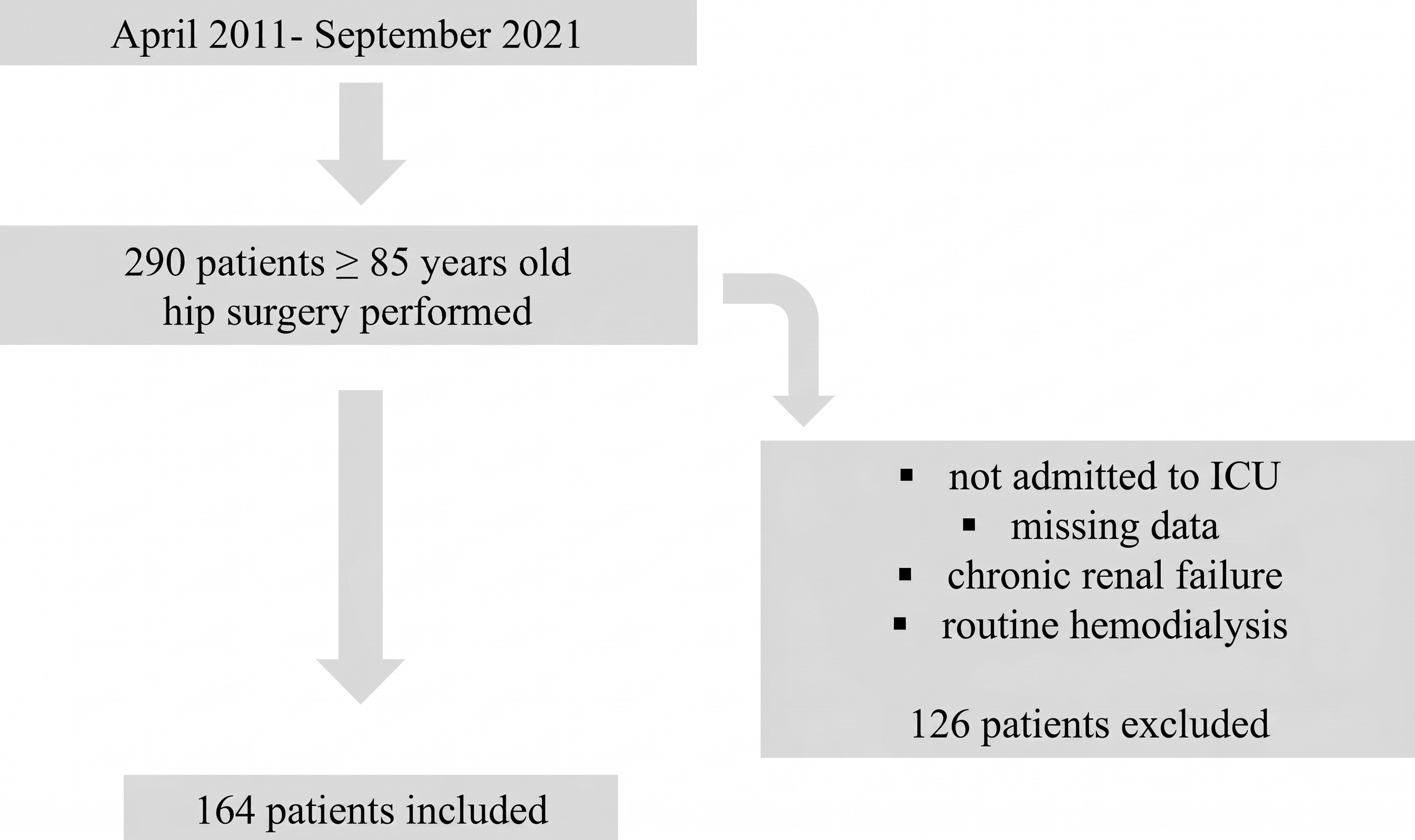
During the study period, hip surgery was performed on 290 patients over the age of 85. One hundred sixty-four of these patients were admitted to the ICU during the postoperative period (Figure 1). Of the 164 patients included in this study, 122 (74.4%) were female, and the mean age was 89.6 ± 3.5 years (between 85–103 years). Forty-four patients (26.8%) had postoperative AKI. Most of the patients (65.2%) were admitted from an emergency service. According to functional status, 135 patients (82.3%) were independent, 20 (12.2%) were partially dependent, and nine (5.5%) were in nursing homes. The most common comorbidity was hypertension (HT) (82.9). HT, CAD, and renal diseases were more common in the AKI group when compared to the non-AKI group (93.2% vs. 79.7% p = 0.02; 38.6% vs. 20.0% p = 0.01, 15.9% vs. 10.0% p = 0.003, respectively). The use of preoperative diuretic drugs was higher in the AKI group when compared to the non-AKI group (22.7% vs. 8.3%, p = 0.01) (Table 1).
| SD: Standart Deviation, AKI: Acute Kidney Injury, ICU: Intensive Care Unit, ACEi: Angiotensin Converting Enzyme Inhibitors, ARBs: , NSAIDs: Non-steroid antiinflamtuary drugs | ||||
| Table 1. Demographic and clinical characteristics of the oldest old patients (n=164). | ||||
| Variables |
|
|||
|
|
|
|
|
|
| Age, years, |
|
|
|
|
| Body Mass Index (kg/m2) |
|
|
|
|
|
|
||||
| Sex |
|
|||
| Male |
|
|
|
|
| Female |
|
|
|
|
| Admission to ICU |
|
|||
| Emergency Room |
|
|
|
|
| Other Wards in Hospital |
|
|
|
|
| Functional State |
|
|||
| Independent |
|
|
|
|
| Partially dependent |
|
|
|
|
| Nursing home |
|
|
|
|
| Comorbidities | ||||
| Hypertension |
|
|
|
|
| Diabetes Mellitus |
|
|
|
|
| Congestive heart failure |
|
|
|
|
| Coronary Artery Diseases |
|
|
|
|
| Valvular Heart Diseases |
|
|
|
|
| Atriall Fibrilattion |
|
|
|
|
| Respiratory Diseases |
|
|
|
|
| Alzheimer |
|
|
|
|
| Malignancy |
|
|
|
|
| Renal Diseases |
|
|
|
|
| Staying in a Nursing Home |
|
|
|
|
| Preoperatively used drugs | ||||
| ACEi/ARBs |
|
|
|
|
| Diuretics |
|
|
|
|
| Anticoagulants |
|
|
|
|
| Antiaggregants |
|
|
|
|
| NSAIDs |
|
|
|
|
| Radiocontrasts |
|
|
|
|
Interthoracanteric femur fractures were the most common type of fracture (62.8%). Proximal femoral nail antirotation (PFNA) was the most common type of surgery (64.1%). According to the ASA score, 102 patients (62.2%) had an ASA score of 3. There was not statistically significant difference in terms of fracture/surgery type, use of preoperative antibiotics, and blood/blood product between the groups. Preoperative EF was lower in the AKI group when compared to the non-AKI group (44.7 ± 17.4 vs. 52.4 ± 11.3, p = 0.01) (Table 2).
| AKI: Acute Kidney Injury, PFNA: Proximal Femoral Nail Antirotation, UTI: Urinary Tract Infection, SD: Standart Deviation, ASA: The American Society of Anaesthesiologists’ classification, PRBCs: Packed Red Blood Cells, FFP: Fresh Frozen Plasma, SD: Standart Deviation. | ||||
| Table 2. Preoperative, intraoperative ve postoperative characteristics of the oldest old patients. | ||||
| Variables |
|
|||
|
|
|
|
|
|
| Surgical Urgency |
|
|||
| Emergency |
|
|
|
|
| Urgent |
|
|
|
|
| Elective |
|
|
|
|
| Types of Fracture |
|
|||
| Subtrochanteric |
|
|
|
|
| Femoral neck |
|
|
|
|
| Interthorachanteric femur |
|
|
|
|
| Types of Surgery |
|
|||
| Total Hip Replacement |
|
|
|
|
| Partial Hip Replacement |
|
|
|
|
| PFNA |
|
|
|
|
| Presence of UTI |
|
|
|
|
| Usage of Antibiotics |
|
|
|
|
| ASA classification |
|
|||
| 2 |
|
|
|
|
| 3 |
|
|
|
|
| 4 |
|
|
|
|
| 5 |
|
|
|
|
| Usage of Blood/Blood Product |
|
|
|
|
|
|
||||
| Peripheral Oxygen Saturation |
|
|
|
|
| Ejection Fraction (%) |
|
|
|
|
|
|
||||
| Type of Anesthesia |
|
|||
| General |
|
|
|
|
| Spinal |
|
|
|
|
| General+Spinal |
|
|
|
|
| PRBCs transfusion |
|
|
|
|
| FFP transfusion |
|
|
|
|
| Bradicardia <60 per minute |
|
|
|
|
| Tachicardia >100 per minute |
|
|
|
|
| Ephedrine use |
|
|
|
|
| Noradrenaline use |
|
|
|
|
| Adrenaline use |
|
|
|
|
| Colloid fluid use |
|
|
|
|
|
|
||||
| Duration of Surgery (minute) |
|
|
|
|
| Sistolic Blood Pressure (mmHg) |
|
|
|
|
| Diastolic Blood Pressure |
|
|
|
|
| Mean Arterial Pressure |
|
|
|
|
| Glucose (mg/dl) |
|
|
|
|
| Lactate (mmol/L) |
|
|
|
|
|
|
||||
| PRBCs transfusion |
|
|
|
|
| FFP transfusion |
|
|
|
|
| Noradrenaline use |
|
|
|
|
| Adrenaline use |
|
|
|
|
Spinal anesthesia was the most common used type of anesthesia (81.8%). Ephedrine usage was higher in the non-AKI group than in the AKI group (24.4% vs. 9.1%, p = 0.02). The mean duration of surgery was 151.3 ± 56.7 minutes. SBP was lower in the non-AKI group than the other group (91.0 ± 20.7 mmHg vs. 98.4 ± 22.8 mmHg, p = 0.037) during the intraoperative period. No statistically significant difference was found in terms of intraoperative blood/blood product usage, adrenaline, noradrenaline usage, MAP, and lactate levels between the groups (Table 2).
The mean APACHE II score was 13.7 ± 4.5, the mean GCS score was 14.8 ± 0.8, and the mean SOFA score was 2.5 ± 1.8 at ICU admission. Heart rate per minute was lower in the group with AKI than in the group without AKI (77.5 ± 17.4 vs. 87.6 ± 23.2, p = 0.008) at ICU admission. The SOFA scores on postoperative 1st (2.9 ± 2.8 vs. 2.0 ± 1.6 p = 0.04), 2nd (2.6 ± 2.5 vs. 1.7 ± 1.5 p = 0.01), and 3rd (2.2 ± 2.3 vs. 1.5 ± 1.7 p = 0.01) days were significantly higher in the group with AKI than in the group without AKI. The SBP, DBP, and MAP on the second postoperative day were significantly lower in the group with AKI when compared to the other group (114.1±15.0 mmHg vs. 120.1 ± 15.0 p = 0.04; 64.8 ± 11.4 mmHg vs. 69.7 ± 9.6 p = 0.01; 80.7 ± 11.3 mmHg vs. 85.8 ± 9.9 p = 0.01, respectively) (Table 3). No statistically significant difference was found in terms of postoperative blood/blood product, noradrenaline, adrenaline, or ephedrine usage between the groups (Table 2).
The length of ICU stay was statistically significantly longer in the group with AKI than the other group (2.7 ± 4.7 vs. 1.6 ± 2.8, p = 0.004). The length of hospital stay before ICU admission and after ICU discharge were similar between the groups. There was no statistically significant difference between the two groups in terms of ICU, hospital, and 30-day mortality rates (Table 3).
In the AKI group, preoperative lymphocyte levels (1.1 ± 0.5 vs. 2.4 ± 3.8 103/µl, p = 0.019) and prothrombin time (PT) (16.5 ± 13.1 vs. 29.6 ± 15.5 seconds, p = 0.036) were lower when compared to the non-AKI group. The postoperative lymphocyte levels (1.3 ± 1.7 vs. 1.7 ± 2.4 103/µl, p = 0.002) were lower and PTs (16.6 ± 10.5 vs. 14.1 ± 7.1 second, p < 0.001) were higher in the group with AKI compared to the group without AKI (Table 4).
According to a logistic regression analysis, preoperative HT (p = 0.03, OR: 0.274, CI: 95% 0.062–1.208,), diuretics usage (p = 0.01, OR: 0.272, CI: 95% 0.077–0.962), preoperative low lymphocyte level (p = 0.03, OR: 0.274, CI: 95% 0.062-–1.208), low heart rate per minute on ICU admission (p = 0.01, OR: 0.975, CI: 95% 0.951–0.998), high SOFA scores on postoperative 1st, 2nd, and 3rd days (p = 0.01, OR: 1.089, CI: 95% 0.574–2.068; p = 0.007, OR: 1.302, CI: 95% 0.618–2.742; p = 0.01, OR: 1.089, CI: 95% 0.574–2.068), and low MAP on the postoperative 2nd day (p = 0.009, OR: 1.045, CI: 95% 0.919–1.137) after hip fracture operation were independent risk factors about postoperative AKI among oldest-old patients (Table 5).
| CI: Confidence Interval; ICU: Intensive Care Unit; SOFA: Sequential Organ Failure Assessment; MAP: Mean Arterial Pressure. | |||
| Table 5. Logistic regression model of risk factors for postoperative acute kidney injury. | |||
| Risk factors |
|
|
|
| Preoperative Hypertension |
|
|
|
| Preoperative usage of diuretics |
|
|
|
| Preoperative lymphopenia |
|
|
|
| Low heart rate on ICU admission |
|
|
|
| High SOFA score on first day of ICU admission |
|
|
|
| High SOFA score on 2nd day of ICU admission |
|
|
|
| High SOFA score on 3rd day of ICU admission |
|
|
|
| Low MAP on 2nd day of ICU admission |
|
|
|
Discussion
In the current clinical trial, the incidence of AKI after hip fracture surgery among the oldest-old patients was 26.8%.
The incidence of AKI was between 15.3% and 60% among elderly patients who underwent hip fracture operation in previous studies (2-5). In this current study, the incidence for postoperative AKI after hip fracture operation was 26.8%, as in previous studies. The aging process decreases renal reserve and glomerular filtration rate, impairs renal autoregulation and perfusion, and increases sensitivity to nephrotoxic agents. Increased comorbidities (especially cardiovascular diseases) also cause renal dysfunction. Both physiological and structural changes are associated with AKI in elderly patients (2,12,15).
In our study, HT was more common in the group with AKI when compared to the other group, and preoperative HT was an independent risk factor for the occurence of postoperative AKI. A retrospective cohort study reported a 22% increased risk of having with a blood pressure of >140/90 mmHg in those with AKI compared to those without AKI, after adjusting for some cardiac risk factors and demographic characteristics (16). Hardening, narrowing or weakening of the renal arteries may occur in patient with uncontrolled high blood pressure. Thus, these damaged arteries cannot deliver enough blood to the renal tissue.
When arteries are damaged, necessary nutrients and oxygen cannot reach the nephrons. Thus, the kidneys cannot filter the blood and regulate the balance of water, salts, acids and hormones in the body (17). Previous clinical studies reported that hypertension is a risk factor for AKI (2,3,10,12), and hypertension is also common in patients who have AKI, especially after hip operation, like our results (2,3,18).
In the AKI group of our cohort, we found that CADs and renal disease were more common than in the non-AKI group, as in previous studies (2-4,8,10,19). Atherosclerosis and decreased heart function may be common in patients with preexisting CADs. These clinical conditions increase renal vasoconstriction and decrease renal perfusion, and thus may cause AKI (2,4,10,17-19). Advanced age and surgery may also cause AKI to occur (10,12,15,18).
In the AKI group of our cohort, preoperative usage of diuretic drugs was more common than in the non-AKI group and was an independent risk factor about the occurence of postoperative AKI in our study. Elderly patients have some risk factors that may contribute to the development of AKI, including age-related anatomic and physiologic changes of kidney, increased comorbidity, increased number of drug usage, and changes of medication metabolism (3,4,10,18).
Loop diuretics cause venodilation and diuresis. Thus, it can reduce the effective volume in glomerular filtration rate, renal blood flow and circulation. When loop diuretics are used, acidification of the urine and accumulation of Tamm-Horsfall protein may be increased. Therefore, it is believed that it may cause tubular obstruction (20).
In the AKI group of our cohort, preoperative EF was lower compared to the non-AKI group. Heart failure with low EF or preserved EF leads to impaired myocardial stretchability and decreased cardiac output. Low cardiac output causes decreased renal perfusion, excited sympathetic systems and increased activation of the renin- aldosterone- angiotensin. Thus, water-salt retention increases and causes increased venous congestion. Renal function is worsened by increased renal venous and intra-abdominal pressure (18,21).
When compared to the non- AKI group, heart rate at ICU admission was lower in the AKI group of our cohort, and low heart rate on ICU admission was an independent risk factor about the occurence of postoperative AKI. Bradycardia arrhythmia or tachycardia may temporarily reduce cardiac output; thus, renal autoregulation may be impaired, and renal perfusion may be reduced (22). Low blood volume, such as hypovolemia, decreased cardiac contraction and contraction frequency (heart rate) as a result of heart failure, liver failure, or sepsis, and vascular structures, such as vasculitis, may reduce renal perfusion and cause renal injury (17). Decreased cardiac output with bradycardia reduces renal perfusion and causes AKI.
The SOFA score system include 6 organ systems: coagulation, neurological, renal, cardiovascular, hepatic and respiratory systems. Higher severity scores are expected among patients who have AKI. In the AKI group of our cohort study, the SOFA scores on postoperative 1st, 2nd, and 3rd days were significantly higher compared to the non-AKI group. High SOFA scores on postoperative 1st, 2nd, and 3rd days were determined as independent risk factors for the occurence of postoperative AKI. Jiang et al. reported that ICU patients with AKI had higher median SOFA scores, and high SOFA scores were independent predictors of mortality (8). In the AKI_EPI study, patients with AKI with a higher Simplified Acute Physiology Score (SAPS) were more severely ill upon admission to the ICU (7). APACHE II, SAPS II, and SOFA scores were accepted as predictors of mortality in elderly patients with AKI. The SOFA score is a useful severity score for predicting the clinical outcomes of patients admitted to the ICU (23).
On the second postoperative day SBP, DBP, and MAP levels were significantly lower in the group with AKI when compared to the other group. Low MAP on the postoperative 2nd day was an independent risk factor about the occurence of postoperative AKI in our cohort. Braüner Christensen et al. reported that SBP/DBP on postoperative days 1 and 2 were significantly lower among patients with AKI after surgery (2). Low blood pressure can cause to decreased renal blood flow and, thus, the occurrence of AKI.
Several studies have shown an association between decreased renal perfusion due to intraoperative hypotension and AKI (23,24). Autoregulation of blood pressure may be impaired among patients with hypertension, chronic renal disease, and atherosclerosis (2,18,23). In a diagnosis of AKI, serum creatinine levels within seven days are evaluated according to KDIGO criteria (4). Thus, hypotension observed on a postoperative 2nd day may cause postoperative AKI. Previous studies presented hypotension as an impotant risk factor for occurrence of AKI in ICU patients, like our findings (17,23).
In the AKI group of our study, preoperative and postoperative lymphocyte levels were lower compared to the non-AKI group, and preoperative lymphopenia was an independent risk factor for the development of postoperative AKI. Each leukocyte subgroup (neutrophil, lymphocyte, monocyte, eosinophil) has a serious role in organ damage and response to injury of inflammation and immunological conditions (24).
It is known that the risk of long-term renal outcomes is associated with the change in leukocyte count. Lymphopenia and monocytopenia in leukopenia may have an association with a higher risk of AKI, whereas neutrophilia in leukocytosis is associated with this risk. Neutropenia and lymphopenia may be associated with higher mortality. T and B lymphocytes cause a natural and adaptive inflammatory response that can lead to the inflammatory process of AKI. Regulatory T lymphocytes are potent immunosuppressive agents. Decreased T lymphocytes may worsen renal dysfunction. Natural killer T cells may play both proinflammatory and protective roles in AKI (25).
The AKI group had prolonged the length of ICU stay compared to the non-AKI group, as in previous studies (3,7,8,12). Among elderly patients with AKI, old age and concomitant comorbidities are risk factors that facilitate the occurence of organ failure. In elderly patients, the natural aging process reduces functional organ reserve. Therefore, risk factors for postoperative AKI may cause organ failures. The need for organ support after acute diseases may be seen in older patients (3). Therefore, the length of stay in hospital and ICU may be long.
Our study has some limitations such as being a retrospective study and a single-center. Therefore, the results cannot be generalized. The data of patients was obtained from digital records.
Conclusion
The incidence for postoperative AKI after hip fracture operation was 26.8% in our cohort study. Preoperative HT, usage of diuretics, preoperative lymphopenia, low heart rate at ICU admission, high SOFA scores on postoperative 1st, 2nd, and 3rd days, and low MAP on postoperative 2nd day were independent risk factors about postoperative AKI after hip fracture operation among the oldest-old patients. Postoperative AKI after hip fracture surgery among patients 85 years and older causes impaired quality of life, prolonged ICU and hospital stay, and increased mortality. The incidence of postoperative complications and deaths may increase due to decreased vital organs reserves in elderly patients. Any effort to identify relevant risk factors associated with AKI in patients ≥ 85 years old who undergo hip fracture surgery could affect the quality of therapies, improve our understanding of the clinical outcomes, shorten the length of an ICU/hospital stay, and reduce mortality among patients with hip fracture.
Ethical approval
This study has been approved by the Başkent University Institutional Review Board (approval date: 09.03.2022, number: KA22/111). Written informed consent was obtained from the participants.
Source of funding
The authors declare the study received no funding.
Conflict of interest
The authors declare that there is no conflict of interest.
References
- Maxwell BG, Spitz W, Porter J. Association of increasing use of spinal anesthesia in hip fracture repair with treating an aging patient population. JAMA Surg. 2020;155:167-8. https://doi.org/10.1001/jamasurg.2019.4471
- Braüner Christensen J, Aasbrenn M, Sandoval Castillo L, et al. Predictors of acute kidney injury after hip fracture in older adults. Geriatr Orthop Surg Rehabil. 2020;11:2151459320920088. https://doi.org/10.1177/2151459320920088
- Hong SE, Kim TY, Yoo JH, et al. Acute kidney injury can predict in-hospital and long-term mortality in elderly patients undergoing hip fracture surgery. PLoS One. 2017;12:e0176259. https://doi.org/10.1371/journal.pone.0176259
- Porter CJ, Moppett IK, Juurlink I, Nightingale J, Moran CG, Devonald MAJ. Acute and chronic kidney disease in elderly patients with hip fracture: prevalence, risk factors and outcome with development and validation of a risk prediction model for acute kidney injury. BMC Nephrol. 2017;18:20. https://doi.org/10.1186/s12882-017-0437-5
- Kurth MJ, McBride WT, McLean G, et al. Acute kidney injury risk in orthopaedic trauma patients pre and post surgery using a biomarker algorithm and clinical risk score. Sci Rep. 2020;10:20005. https://doi.org/10.1038/s41598-020-76929-y
- Kang JS, Moon KH, Youn YH, Park JS, Ko SH, Jeon YS. Factors associated with postoperative acute kidney injury after hip fractures in elderly patients. J Orthop Surg (Hong Kong). 2020;28:2309499019896237. https://doi.org/10.1177/2309499019896237
- Hoste EA, Bagshaw SM, Bellomo R, et al. Epidemiology of acute kidney injury in critically ill patients: the multinational AKI-EPI study. Intensive Care Med. 2015;41:1411-23. https://doi.org/10.1007/s00134-015-3934-7
- Jiang L, Zhu Y, Luo X, et al. Epidemiology of acute kidney injury in intensive care units in Beijing: the multi-center BAKIT study. BMC Nephrol. 2019;20:468. https://doi.org/10.1186/s12882-019-1660-z
- Lertjitbanjong P, Thongprayoon C, Cheungpasitporn W, et al. Acute kidney injury after lung transplantation: a systematic review and meta-analysis. J Clin Med. 2019;8:1713. https://doi.org/10.3390/jcm8101713
- Thongprayoon C, Kaewput W, Thamcharoen N, et al. Acute kidney injury in patients undergoing total hip arthroplasty: a systematic review and meta-analysis. J Clin Med. 2019;8:66. https://doi.org/10.3390/jcm8010066
- Li ZC, Pu YC, Wang J, Wang HL, Zhang YL. The prevalence and risk factors of acute kidney injury in patients undergoing hip fracture surgery: a meta-analysis. Bioengineered. 2021;12:1976-85. https://doi.org/10.1080/21655979.2021.1926200
- Xu L, Wu Y, Chen Y, et al. Is acute kidney injury age-dependent in older adults: an observational study in two centers from North China. BMC Geriatr. 2021;21:7. https://doi.org/10.1186/s12877-020-01906-z
- Khwaja A. KDIGO clinical practice guidelines for acute kidney injury. Nephron Clin Pract. 2012;120:c179-84. https://doi.org/10.1159/000339789
- Alterovitz SS, Mendelsohn GA. Relationship goals of middle-aged, young-old, and old-old Internet daters: an analysis of online personal ads. J Aging Stud. 2013;27:159-65. https://doi.org/10.1016/j.jaging.2012.12.006
- Chao CT, Wu VC, Lai CF, et al. Advanced age affects the outcome-predictive power of RIFLE classification in geriatric patients with acute kidney injury. Kidney Int. 2012;82:920-7. https://doi.org/10.1038/ki.2012.237
- Hsu CY, Hsu RK, Yang J, Ordonez JD, Zheng S, Go AS. Elevated BP after AKI. J Am Soc Nephrol. 2016;27:914-23. https://doi.org/10.1681/ASN.2014111114
- Kellum JA, Romagnani P, Ashuntantang G, Ronco C, Zarbock A, Anders HJ. Acute kidney injury. Nat Rev Dis Primers. 2021;7:52. https://doi.org/10.1038/s41572-021-00284-z
- Cho W, Hwang TY, Choi YK, et al. Diastolic dysfunction and acute kidney injury in elderly patients with femoral neck fracture. Kidney Res Clin Pract. 2019;38:33-41. https://doi.org/10.23876/j.krcp.18.0083
- Biteker M, Dayan A, Tekkeşin Aİ, et al. Incidence, risk factors, and outcomes of perioperative acute kidney injury in noncardiac and nonvascular surgery. Am J Surg. 2014;207:53-9. https://doi.org/10.1016/j.amjsurg.2013.04.006
- Ho KM, Power BM. Benefits and risks of furosemide in acute kidney injury. Anaesthesia. 2010;65:283-93. https://doi.org/10.1111/j.1365-2044.2009.06228.x
- Anand IS. Cardiorenal syndrome: a cardiologist’s perspective of pathophysiology. Clin J Am Soc Nephrol. 2013;8:1800-7. https://doi.org/10.2215/CJN.04090413
- Mehta RL, Kellum JA, Shah SV, et al. Acute Kidney Injury Network: report of an initiative to improve outcomes in acute kidney injury. Crit Care. 2007;11:R31. https://doi.org/10.1186/cc5713
- Ahlström A, Kuitunen A, Peltonen S, et al. Comparison of 2 acute renal failure severity scores to general scoring systems in the critically ill. Am J Kidney Dis. 2006;48:262-8. https://doi.org/10.1053/j.ajkd.2006.04.086
- Jang WY, Jung JK, Lee DK, Han SB. Intraoperative hypotension is a risk factor for postoperative acute kidney injury after femoral neck fracture surgery: a retrospective study. BMC Musculoskelet Disord. 2019;20:131. https://doi.org/10.1186/s12891-019-2496-1
- Fried L, Solomon C, Shlipak M, et al. Inflammatory and prothrombotic markers and the progression of renal disease in elderly individuals. J Am Soc Nephrol. 2004;15:3184-91. https://doi.org/10.1097/01.ASN.0000146422.45434.35
Copyright and license
Copyright © 2026 The Author(s). This is an open access article distributed under the Creative Commons Attribution License (CC BY), which permits unrestricted use, distribution, and reproduction in any medium or format, provided the original work is properly cited.