

Abstract
Objective: This study aimed to evaluate the independent effect of obesity on C-reactive protein (CRP) and procalcitonin levels in intensive care unit (ICU) patients with sepsis.
Methods: This retrospective, single-center observational study included adult patients admitted to the ICU with a diagnosis of sepsis or who developed sepsis during ICU follow-up between January and December 2025. Patients were classified as non-obese (BMI <30 kg/m²) or obese (BMI ≥30 kg/m²). CRP, procalcitonin, and Sequential Organ Failure Assessment (SOFA) scores were recorded at the time of sepsis diagnosis. Mann–Whitney U and chi-square tests were used for group comparisons; the independent effect of obesity was assessed by multivariable regression analysis.
Results: A total of 359 sepsis patients were included; 81 (22.6%) were obese. No significant differences were observed between groups in terms of age, SOFA score, or Charlson Comorbidity Index (CCI). Although CRP and procalcitonin levels showed a trend toward higher values in the obese group, no statistically significant difference was detected (p=0.135 and p=0.260, respectively). In multivariable analysis, obesity was not independently associated with CRP (expβ 1.16; 95% CI 0.86–1.56; p=0.321) or procalcitonin (expβ 1.49; 95% CI 0.88–2.51; p=0.136) levels. ICU mortality was similar between groups (63.0% vs. 68.3%; p=0.439).
Conclusion: No independent effect of obesity on CRP and procalcitonin levels was demonstrated at the time of sepsis diagnosis. Clinical context and concomitant metabolic conditions should be taken into account when interpreting inflammatory biomarkers in obese patients with sepsis.
Keywords: sepsis, obesity, C-reactive protein, procalcitonin, intensive care unit
Introduction
Sepsis remains one of the leading causes of mortality and morbidity in intensive care units (ICUs) worldwide. According to the Sepsis-3 consensus definition, sepsis is defined as life-threatening organ dysfunction caused by a dysregulated host response to infection (1). The heterogeneity of the host response substantially influences both the clinical course of sepsis and the diagnostic and prognostic value of inflammatory biomarkers.
Obesity is a clinically important condition that can modulate the inflammatory response during sepsis through chronic low-grade inflammation, adipokine dysregulation, and alterations in immune function. The secretion of pro-inflammatory cytokines such as interleukin-6, tumour necrosis factor-alpha, and leptin by adipose tissue may lead to both quantitative and qualitative differences in the host response to infection in obese patients (2,3).
C-reactive protein (CRP) and procalcitonin (PCT) are widely used inflammatory biomarkers for diagnosing and monitoring sepsis. CRP is an acute-phase protein synthesised in the liver in response to inflammation; its baseline levels may be elevated in the context of obesity-related chronic low-grade inflammation (4). PCT, in contrast, is a marker that rises markedly in bacterial infections but is suppressed in viral infections (5). Although adipose tissue has been shown to produce PCT and obesity-associated hyperprocalcitonaemia has been documented, the clinical relevance of this phenomenon in the setting of acute sepsis remains unclear (6,7).
The relationship between obesity and sepsis mortality has been debated within the framework of the “obesity paradox.” At the same time, some studies have reported reduced mortality in obese patients; these findings remain inconsistent, particularly in cohorts comprising elderly and critically ill patients (8,9). Whether CRP and PCT responses at the time of sepsis diagnosis are independently altered in the presence of obesity represents a question of critical clinical importance, since standard biomarker threshold values have largely been established in non-obese populations and their direct extrapolation to obese patients rests on an assumption that warrants scrutiny. A substantial proportion of existing studies have employed pre-Sepsis-3 diagnostic criteria; many have small sample sizes and rely on unadjusted single-variable comparisons without controlling for disease severity or comorbidity burden, thereby precluding adequate adjustment for confounding. No multivariable analysis specific to a Turkish ICU population currently exists.
This study aimed to evaluate the independent effect of obesity on CRP and PCT levels at the time of sepsis diagnosis in ICU patients meeting Sepsis-3 criteria, using multivariable regression analysis adjusted for disease severity and comorbidity burden.
Materials and methods
Study design and patient selection
This retrospective, single-centre observational study was conducted at the Ondokuz Mayıs University Mikail Yüksel Intensive Care Unit between January 2025 and December 2025. Adult patients aged 18 years or older who were admitted to the ICU with a diagnosis of sepsis or who developed sepsis during their ICU stay were included. Sepsis was diagnosed in accordance with the Sepsis-3 consensus definition, based on a ≥2-point increase in the Sequential Organ Failure Assessment (SOFA) score in the presence of suspected infection (1).
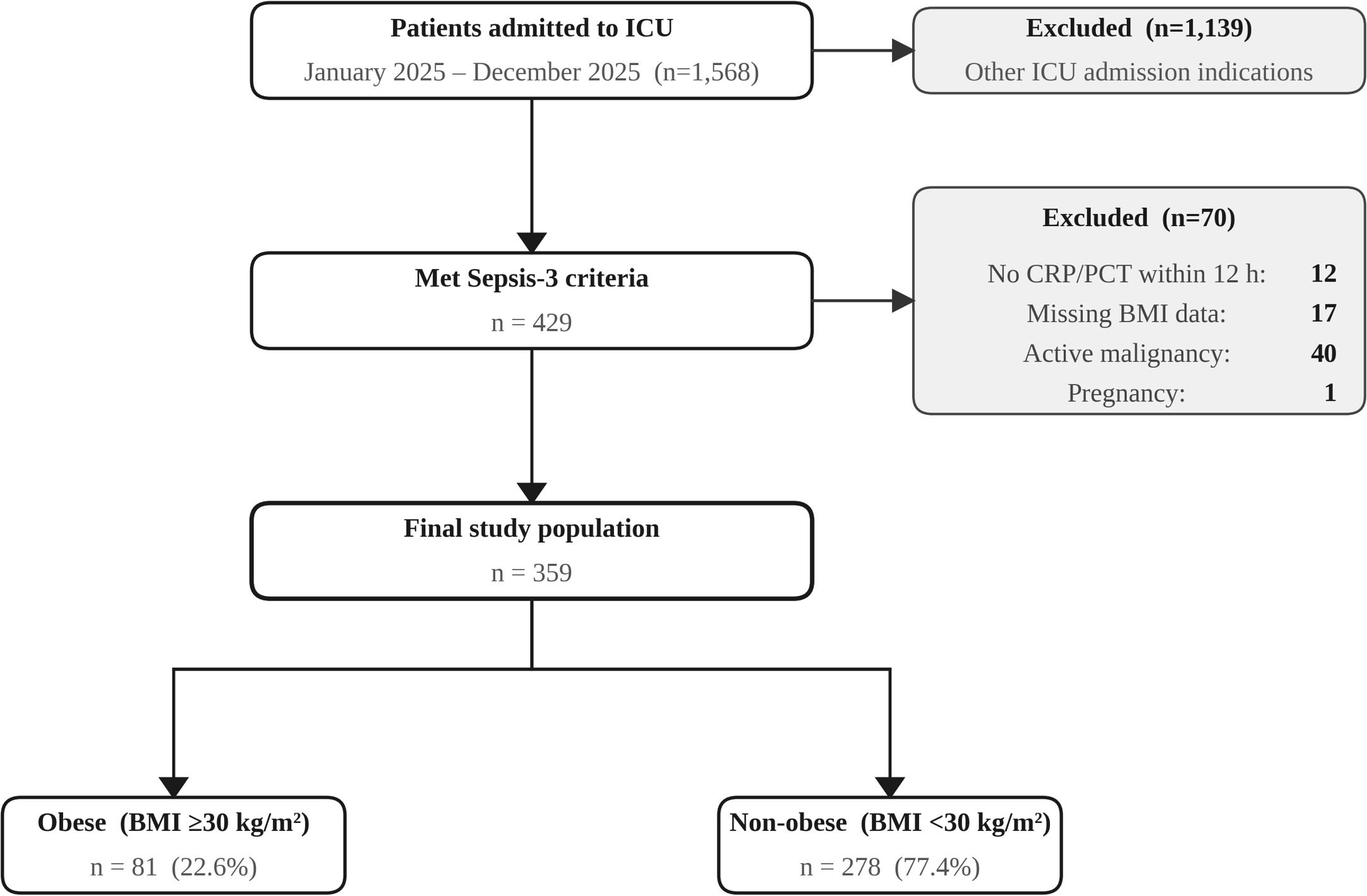
Inclusion criteria were: (i) age ≥18 years; (ii) diagnosis of sepsis according to Sepsis-3 criteria; (iii) availability of CRP and procalcitonin measurements at the time of sepsis diagnosis; and (iv) availability of height and weight data for BMI calculation. Exclusion criteria were: (i) age <18 years; (ii) pregnancy; (iii) active malignancy; (iv) missing BMI or primary biomarker data; and (v) for patients with recurrent ICU admissions during the same hospitalisation, all records other than the first admission. All patients enrolled in the study were consecutive cases meeting the inclusion criteria during the specified period; no exclusions based on formal sample size calculations were made, and all eligible patients were included in the analysis. The patient selection process is illustrated in Figure 1.
The study was approved by the Ondokuz Mayıs University Clinical Research Ethics Committee (approval no: 2025/712). Informed consent was waived owing to the retrospective study design. The study was conducted in accordance with the principles of the Declaration of Helsinki.
Data collection and variables
Demographic data, comorbidity information, and clinical parameters were obtained from patient records. Patients were classified into two groups based on BMI: non-obese (BMI < 30 kg/m²) and obese (BMI ≥ 30 kg/m²). This cut-off was determined in accordance with the World Health Organization’s international BMI classification (10). BMI was calculated using height and weight values measured by the attending physician at the time of ICU admission and recorded in the patient’s medical file; these values were retrieved retrospectively from patient records [BMI = weight (kg) / height² (m²)]. Comorbidity burden was assessed using the Charlson Comorbidity Index (CCI) (11). The degree of organ dysfunction was determined by the SOFA score recorded at the time of sepsis diagnosis (12).
The primary outcomes were serum CRP (mg/L) and procalcitonin (ng/mL) levels measured at the time of sepsis diagnosis. Secondary outcomes were ICU mortality and ICU length of stay. CRP and procalcitonin were measured within the first 12 hours following the diagnosis of sepsis, while lactate and creatinine values were obtained at the time of diagnosis as part of routine clinical care.
Statistical analysis
Statistical analyses were performed using SPSS version 26.0 (IBM Corp., Armonk, NY, USA). Normality of continuous variables was assessed using the Kolmogorov-Smirnov test; as distributions were skewed, continuous variables are presented as median (interquartile range, IQR). Categorical variables are expressed as numbers and percentages.
Between-group comparisons for continuous variables were performed using the Mann–Whitney U test, and categorical variables were compared using the chi-square test or Fisher’s exact test where appropriate. The independent effect of obesity on CRP and procalcitonin levels was assessed using multivariable linear regression, adjusted for age, sex, SOFA score, and CCI. Logarithmic transformations were applied to CRP and procalcitonin owing to their right-skewed distributions; results are reported as exponentiated coefficients (exp (β)) with 95% confidence intervals (95% CI). A p-value of <0.05 was considered statistically significant.
This observational cohort study was prepared and reported in accordance with the STROBE (Strengthening the Reporting of Observational Studies in Epidemiology) reporting guideline.
Results
A total of 359 patients with sepsis were included; 81 (22.6%) were classified as obese and 278 (77.4%) as non-obese. No statistically significant difference was observed between the two groups with respect to age [70.0 (61.0–77.0) vs. 69.0 (56.0–78.0) years; p=0.536], CCI [7.0 (5.0–9.0) vs. 7.0 (5.0–9.0); p=0.723], or SOFA score [9.0 (5.0–13.0) vs. 10.0 (7.0–12.0); p=0.537]. Male sex was significantly more prevalent in the non-obese group (61.9% vs. 29.6%; p<0.001). Baseline clinical and laboratory characteristics of both groups are presented in Table 1.
|
IQR: interquartile range; BMI: body mass index; CRP: C-reactive protein; ICU: intensive care unit. Mann-Whitney U test was used for continuous variables and chi-square test for categorical variables. |
||||
| Table 1. Baseline demographic, clinical and laboratory characteristics of patients. | ||||
| Variable |
|
|
|
|
| Age, years — median (IQR) |
|
|
|
|
| Male sex — n (%) |
|
|
|
|
| BMI, kg/m² — median (IQR) |
|
|
|
|
| Charlson Comorbidity Index — median (IQR) |
|
|
|
|
| SOFA score — median (IQR) |
|
|
|
|
| CRP, mg/L — median (IQR) |
|
|
|
|
| Procalcitonin, ng/mL — median (IQR) |
|
|
|
|
| Lactate, mmol/L — median (IQR) |
|
|
|
|
| Creatinine, mg/dL — median (IQR) |
|
|
|
|
| ICU length of stay, days — median (IQR) |
|
|
|
|
| ICU mortality — n (%) |
|
|
|
|
Although the primary outcomes — CRP and procalcitonin levels — were numerically higher in the obese group, no statistically significant between-group difference was observed [CRP: 145.0 (70.0–239.0) vs. 112.0 (48.0–191.0) mg/L; p=0.135, and procalcitonin: 2.1 (0.5–12.8) vs. 1.5 (0.4–6.9) ng/mL; p=0.260]. In the multivariable regression analysis, after adjustment for age, sex, SOFA score, and CCI, obesity was not independently associated with either CRP (expβ 1.16; 95% CI 0.86–1.56; p=0.321) or procalcitonin (expβ 1.49; 95% CI 0.88–2.51; p=0.136) levels. In the same model, SOFA score emerged as an independent and robust predictor of both CRP (expβ 1.06; 95% CI 1.03–1.09; p<0.001) and procalcitonin (expβ 1.26; 95% CI 1.20–1.32; p<0.001) (Table 2).
|
CI: confidence interval; CRP: C-reactive protein; CCI: Charlson Comorbidity Index; SOFA: Sequential Organ Failure Assessment. Dependent variables were log-transformed; coefficients are presented as expβ. The model was adjusted for obesity, age, sex, SOFA score, and CCI. |
||||
| Table 2. Multivariable regression analysis of the association between obesity and CRP and procalcitonin levels. | ||||
| Variable |
|
|
|
|
| Obesity (reference: non-obese) |
|
|
|
|
| Age (per year) |
|
|
|
|
| Male sex (reference: female) |
|
|
|
|
| SOFA score (per point) |
|
|
|
|
| Charlson Comorbidity Index (per point) |
|
|
|
|
Regarding secondary outcomes, ICU mortality was comparable between the obese and non-obese groups (63.0% vs. 68.3%; p=0.439). The high mortality rates observed in both groups were consistent with the median SOFA score of 9–10 in this cohort, reflecting the critical illness severity of the study population. No significant difference in ICU length of stay was identified [9.0 (5.0–16.0) vs. 8.0 (5.0–14.0) days; p=0.717]. Lactate levels were similar in both groups [2.1 (1.5–2.9) vs. 2.1 (1.4–3.3) mmol/L; p=0.917], whereas creatinine levels were significantly higher in the obese group [2.0 (1.2–3.0) vs. 1.4 (0.9–2.6) mg/dL; p=0.006]. The sex distribution differed markedly between the two groups; male sex was substantially more prevalent in the non-obese group compared with the obese group (61.9% vs. 29.6%; p<0.001). This imbalance reflects the higher likelihood of women meeting the BMI ≥30 kg/m² threshold, and the unequal distribution of male and female patients across both groups constitutes a demographic constraint that must be considered when interpreting outcomes shaped by sex interactions, such as the obesity paradox.
The results of the ROC analysis for the ability of CRP and procalcitonin to predict ICU mortality in the overall patient cohort are presented in Table 3. The AUC for CRP was 0.666 (95% CI 0.606–0.729), and for procalcitonin, 0.691 (95% CI 0.632–0.754). The optimal threshold values determined by the Youden index were ≥137 mg/L for CRP (sensitivity 53.5%, specificity 73.7%) and ≥0.9 ng/mL for procalcitonin (sensitivity 71.8%, specificity 59.3%). In subgroup analyses, the optimal CRP threshold in the obese group was ≥145 mg/L, compared with ≥67 mg/L in the non-obese group; the corresponding procalcitonin thresholds were ≥0.52 ng/mL and ≥1.26 ng/mL, respectively. This difference in CRP thresholds is clinically noteworthy: the mortality signal threshold in obese patients was more than twice that in their non-obese counterparts, suggesting that the chronic inflammatory background associated with adipose tissue may cause CRP to reflect a mortality signal only at substantially higher levels. Nevertheless, AUC differences between the two groups were not statistically significant on DeLong testing for either CRP (Z=0.477; p=0.633) or procalcitonin (Z=−0.036; p=0.971). Spearman correlation coefficients between BMI and CRP (r=0.067; p=0.202) and between BMI and procalcitonin (r=0.046; p=0.388) were also non-significant. ROC curves for both groups are presented in Figure 2.
|
AUC: area under the curve; CI: confidence interval; CRP: C-reactive protein. 95% CI calculated using the bootstrap method (1,000 iterations). Optimal threshold values were determined using the Youden index for the overall cohort and each subgroup separately. AUC differences between obese and non-obese groups were assessed by DeLong test: CRP p=0.633, procalcitonin p=0.971. Caution is advised when interpreting subgroup analyses owing to small sample sizes. |
|||||
| Table 3. ROC analysis results for CRP and procalcitonin in predicting ICU mortality. | |||||
| Group / Biomarker |
|
|
|
|
|
| All patients (n=359) | |||||
| CRP |
|
|
|
|
|
| Procalcitonin |
|
|
|
|
|
| Obese group (n=81) | |||||
| CRP |
|
|
|
|
|
| Procalcitonin |
|
|
|
|
|
| Non-obese group (n=278) | |||||
| CRP |
|
|
|
|
|
| Procalcitonin |
|
|
|
|
|
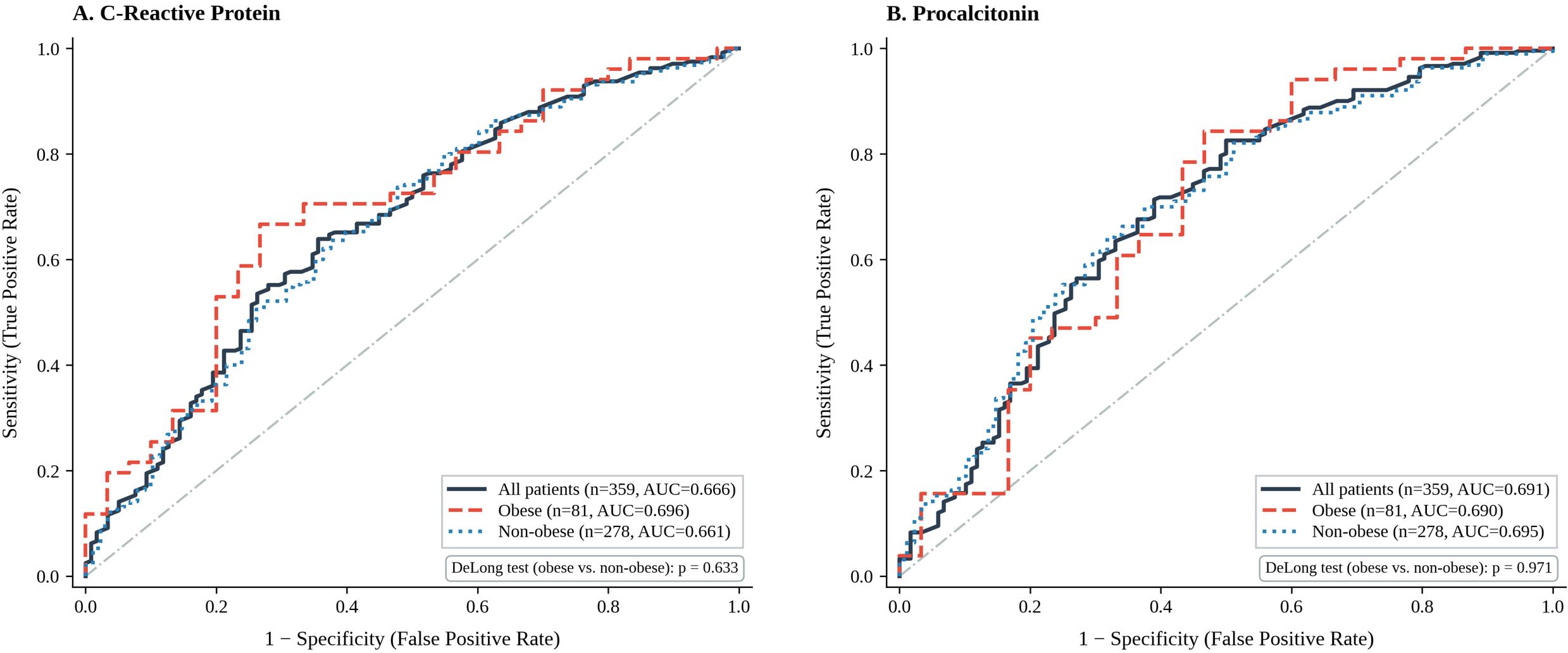
ROC curves are shown for all patients (solid black line), obese patients (dashed red line), and non-obese patients (dotted blue line). The diagonal dashed grey line represents the reference line of no discrimination. AUC differences between obese and non-obese groups were assessed by DeLong test: CRP p=0.633, procalcitonin p=0.971.
Post-hoc power analysis revealed that the observed effect sizes (Cohen’s d=0.219 for CRP and d=0.165 for procalcitonin) were substantially below the threshold for clinical meaningfulness (d=0.355). This finding suggests that the relationship between obesity and these inflammatory biomarkers is of limited clinical significance, rather than indicating an undetected effect in the current sample.
Discussion
This study investigated the relationship between obesity and early inflammatory biomarkers in 359 ICU patients diagnosed with sepsis according to Sepsis-3 criteria. Although CRP and procalcitonin levels were numerically higher in the obese group, obesity was not identified as an independent predictor of either biomarker in multivariable analysis adjusted for age, sex, SOFA score, and CCI. This negative finding constitutes the principal result of our study. It suggests that the relationship between obesity and these inflammatory biomarkers is of limited clinical magnitude, largely overshadowed by the dominant effect of disease severity. The variable that emerged as the strongest independent predictor of both biomarkers in the multivariable model was the SOFA score — a surrogate of disease severity. No significant difference in the prognostic value for mortality prediction was observed between obese and non-obese groups in the ROC analysis; ICU mortality, length of stay, and lactate levels were also comparable. However, creatinine levels were significantly higher in the obese group.
The relationship between obesity and inflammation has long been established. Adipose tissue functions as a metabolically active endocrine organ that continuously secretes pro-inflammatory adipokines, principally interleukin (IL)-6, tumour necrosis factor-alpha (TNF-α), and leptin, establishing a state of chronic low-grade inflammation associated with obesity. Visser et al. demonstrated a positive correlation between BMI and CRP levels in a large population-based study and reported elevated baseline CRP levels in obese individuals (4). Abbasi et al. showed that even procalcitonin values within the normal range were positively associated with BMI and waist circumference, and that obesity, insulin resistance, and the metabolic syndrome significantly elevated procalcitonin levels (7). This pathophysiological basis supports the hypothesis that obese patients with sepsis might be expected to exhibit higher CRP and procalcitonin levels.
Direct evidence on this topic in the literature remains sparse. Simon et al. examined 243 consecutive patients treated for severe sepsis or septic shock according to SCCM criteria in the ICUs of two university hospitals, and reported higher procalcitonin and CRP values in patients with BMI ≥30 kg/m²; however, the difference in log-transformed procalcitonin only approached borderline significance (p=0.052) (6). The relationship was particularly pronounced in patients with positive blood cultures, and the authors emphasised the need for more detailed investigation of adipose tissue’s role in severe sepsis. Abbasi et al. further demonstrated that obesity, insulin resistance, and the metabolic syndrome independently elevated procalcitonin levels in analyses stratified by metabolic phenotype (7), highlighting the influence of metabolic context on biomarker values in the pre-Sepsis-3 era. In our study, examining a cohort meeting Sepsis-3 criteria and substantially greater disease severity, a similar numerical trend was observed. Yet, obesity did not emerge as an independent determinant in the multivariable analysis. Two explanations may account for this discrepancy: first, the suppressive effect of disease severity on the inflammatory response may be considerably stronger in cohorts defined by Sepsis-3 criteria; second, the pure effect of obesity — disentangled from metabolic comorbidities — may be too small to detect at the current sample size.
In our multivariable analysis, the SOFA score emerged as the strongest independent predictor of both CRP (expβ 1.06; 95% CI 1.03–1.09; p<0.001) and procalcitonin (expβ 1.26; 95% CI 1.20–1.32; p<0.001). This finding is directly aligned with the conceptual framework established by the Sepsis-3 consensus definition, in which the SOFA score serves as the operational criterion for organ dysfunction (1). It is well established that both the hepatic acute-phase response and procalcitonin release increase in proportion to the degree of organ dysfunction; consequently, the independent effect of SOFA on inflammatory biomarkers is a biologically expected finding (1). Our data corroborate the SOFA score’s role not only as a predictor of mortality but also as an independent determinant of inflammatory biomarker levels, further suggesting that the obesity-related inflammatory background is relatively attenuated in the face of acute organ dysfunction signals.
The ROC analysis in our study demonstrated that CRP and procalcitonin predicted mortality with comparable accuracy in both groups; the AUC was 0.666 for CRP and 0.691 for procalcitonin. AUC differences between the groups were not statistically significant on DeLong testing (p=0.633 and p=0.971, respectively). These findings are consistent with large-scale studies documenting the limited prognostic performance of CRP and procalcitonin in predicting sepsis mortality. In a multicentre study of 1,772 patients with septic shock based on the Korean Shock Society registry, both biomarkers were elevated in non-survivors. Yet, neither was an independent prognostic predictor in multivariable analysis (13). Similarly, a recent study by Schupp et al. reported poor prognostic AUC values for CRP and procalcitonin about 30-day all-cause mortality in patients with sepsis and septic shock (14). In this context, the Youden threshold analysis yields a clinically noteworthy finding: the optimal CRP mortality threshold in the obese group was ≥145 mg/L, compared with ≥67 mg/L in the non-obese group. Although this AUC difference did not reach statistical significance, the disparity in thresholds suggests that, owing to the chronic inflammatory background derived from adipose tissue, CRP may only begin to carry a mortality signal at substantially higher levels in obese patients.
The most prominent secondary outcome was significantly higher creatinine levels in the obese group (p=0.006). This finding is consistent with the recent study by Ahn et al., published in JAMA Network Open, involving 4,041 patients with sepsis, which demonstrated that obesity is an independent risk factor for early sepsis-associated acute kidney injury (SA-AKI) and that its development adversely affects clinical outcomes (15). The adverse renal effects of obesity are multifactorial and include glomerular hyperfiltration, insulin resistance-mediated tubular injury, activation of the renin-angiotensin-aldosterone system, and direct nephrotoxic effects of pro-inflammatory cytokines derived from adipose tissue. Furthermore, the relatively lower muscle mass in obese patients may undermine creatinine as an adequate reflection of renal dysfunction. This methodological limitation warrants systematic evaluation of the creatinine findings from our study in larger patient series.
About the obesity paradox, ICU mortality in our study was similar between the obese and non-obese groups (63.0% vs. 68.3%; p=0.439). This finding is consistent with the conflicting evidence in the ICU mortality literature about obesity. Yeo et al., in a multicentre prospective Korean cohort of 6,424 patients with sepsis, reported significantly higher in-hospital mortality in the non-obese group compared with the obese group on matched analysis (36.7% vs. 25.3%; p<0.001), attributing this to the classical obesity paradox (8). The meta-analysis by Gao et al. demonstrated that obesity was associated with lower sepsis mortality (OR=0.82; 95% CI 0.69–0.97); however, the authors noted that this protective effect appeared to be less robust in ICU settings and in prospective cohorts (16). Zhang et al., in a large-scale analysis of the MIMIC-IV database, demonstrated that the protective effect of obesity in sepsis varied markedly by age and sex, being most pronounced in elderly male patients (3). In our study, the substantially higher proportion of women in the obese group (70.4%) emerges as a demographic constraint that limits the comparability of the two groups in the context of the obesity paradox. This sex disparity most likely reflects the pattern inherent to BMI-based obesity classification: men more frequently exhibit central obesity and may fall below BMI cut-offs in some populations.
This study has several methodological strengths. The systematic application of the Sepsis-3 definition eliminates the diagnostic heterogeneity observed in many earlier studies. Enrolling consecutive patients who meet the inclusion criteria throughout the study period reduces selection bias. The multivariable analytical design minimises confounding inherent to previously published univariable comparisons and enables a more reliable estimation of the independent effect of obesity. Given the paucity of Sepsis-3 cohort data from Turkey, this study makes an original contribution to the regional literature.
Conversely, the study should be interpreted in light of its limitations. The retrospective, single-centre design limits generalisability compared with prospective multicentre studies. Post-hoc power analysis revealed that the observed effect sizes (Cohen’s d=0.219 for CRP and d=0.165 for procalcitonin) were substantially below the pre-specified clinical threshold. At the same time, this supports the biological plausibility of the negative finding, but it does not entirely exclude the possibility of a type II error. BMI does not fully reflect the quantity or distribution of visceral adipose tissue; future studies incorporating complementary measures such as waist circumference or abdominal computed tomography are recommended to investigate this relationship in greater detail. The markedly higher proportion of women in the obese group (70.4%) limits the comparability of the two groups from a sex-balance perspective, particularly requiring careful interpretation of outcomes involving sex interactions. Finally, the inability to incorporate culture data and the primary infection focus into the analysis restricted the evaluation of pathogen-specific differences in biomarker responses.
Conclusion
This study demonstrates that obesity does not independently affect CRP and procalcitonin levels in ICU patients diagnosed with sepsis according to Sepsis-3 criteria. Although both inflammatory biomarkers were numerically higher in the obese group, this difference lost statistical significance following adjustment for the SOFA score — a key indicator of disease severity. In the multivariable analysis, the strongest independent predictor of CRP and procalcitonin was the SOFA score rather than obesity. While ICU mortality, length of stay, and lactate levels were comparable between groups, significantly elevated creatinine levels in obese patients suggest that obesity may impose an additional burden on renal function during the course of sepsis. The ROC analysis demonstrated that the prognostic value of CRP and procalcitonin for mortality prediction was independent of obesity status, with no statistically significant difference between the two groups. These findings suggest that, in the context of sepsis, obesity alone is not a decisive determinant in the interpretation of inflammatory biomarkers; the primary determinant is the clinical expression of organ dysfunction. Prospective, multicentre studies with larger sample sizes investigating whether this relationship varies with disease severity will provide more definitive guidance for the clinical use of sepsis biomarkers.
Ethical approval
This study has been approved by the Ondokuz Mayıs University Clinical Research Ethics Committee (approval date: 10.09.2024, number: 2025/712). Informed consent was not obtained due to the retrospective design of the study.
Source of funding
The authors declare the study received no funding.
Conflict of interest
The authors declare that there is no conflict of interest.
Generative AI statement
During the preparation of this work, the author(s) utilized Claude (Anthropic) to check grammar and sentence structure in the English manuscript text. After carefully reviewing and editing the content as necessary, full responsibility for the publication’s content is taken by the author(s). This incorporation of AI tool usage primarily affected language editing; data collection, analysis, and interpretation were performed entirely by the authors.
References
- Singer M, Deutschman CS, Seymour CW, et al. The third international consensus definitions for sepsis and septic shock (Sepsis-3). JAMA. 2016;315:801-10. https://doi.org/10.1001/jama.2016.0287
- Shashidhara KC, Sai Malavika I, Meghana BS, Venkatesh CR, Savitha V. Sepsis outcome in patients with metabolic syndrome and its correlation to procalcitonin and C-reactive protein. The Journal Indian Academy of Clinical Medicine. 2024;25(1-2):32-6.
- Zhang T, Li X, Meng Z, et al. Obesity and septic patient outcomes: shaping the puzzle through age and sex perspectives. Clin Nutr. 2024;43:1013-20. https://doi.org/10.1016/j.clnu.2024.03.009
- Visser M, Bouter LM, McQuillan GM, Wener MH, Harris TB. Elevated C-reactive protein levels in overweight and obese adults. JAMA. 1999;282:2131-5. https://doi.org/10.1001/jama.282.22.2131
- Assicot M, Gendrel D, Carsin H, Raymond J, Guilbaud J, Bohuon C. High serum procalcitonin concentrations in patients with sepsis and infection. Lancet. 1993;341:515-8. https://doi.org/10.1016/0140-6736(93)90277-n
- Simon P, Thomas-Rüddel D, Nemes T, Reinhart K, Bloos F, Kaisers UX. Obesity and inflammatory markers in severe sepsis. Crit Care. 2013;17(Suppl 2):P26. https://doi.org/10.1186/cc11964
- Abbasi A, Corpeleijn E, Postmus D, et al. Plasma procalcitonin is associated with obesity, insulin resistance, and the metabolic syndrome. J Clin Endocrinol Metab. 2010;95:E26-31. https://doi.org/10.1210/jc.2010-0305
- Yeo HJ, Kim TH, Jang JH, et al. Obesity paradox and functional outcomes in sepsis: a multicenter prospective study. Crit Care Med. 2023;51:742-52. https://doi.org/10.1097/CCM.0000000000005801
- Li S, Fu Z, Zhang W, Liu H. Impact of obesity on intensive care unit outcomes in older patients with critical illness: a cohort study. PLoS One. 2024;19:e0297635. https://doi.org/10.1371/journal.pone.0297635
- World Health Organization (WHO). Obesity: preventing and managing the global epidemic. Report of a WHO consultation. WHO Technical Report Series, No. 894. Geneva: WHO; 1999. Available at: https://iris.who.int/items/933e09aa-64f9-46e9-8dbb-78d8cddf1a3d
- Charlson ME, Pompei P, Ales KL, MacKenzie CR. A new method of classifying prognostic comorbidity in longitudinal studies: development and validation. J Chronic Dis. 1987;40:373-83. https://doi.org/10.1016/0021-9681(87)90171-8
- Vincent JL, Moreno R, Takala J, et al. The SOFA (sepsis-related organ failure assessment) score to describe organ dysfunction/failure. On behalf of the Working Group on Sepsis-Related Problems of the European Society of Intensive Care Medicine. Intensive Care Med. 1996;22:707-10. https://doi.org/10.1007/BF01709751
- Ryoo SM, Han KS, Ahn S, et al. The usefulness of C-reactive protein and procalcitonin to predict prognosis in septic shock patients: a multicenter prospective registry-based observational study. Sci Rep. 2019;9:6579. https://doi.org/10.1038/s41598-019-42972-7
- Schupp T, Weidner K, Rusnak J, et al. C-reactive protein and procalcitonin during course of sepsis and septic shock. Ir J Med Sci. 2024;193:457-68. https://doi.org/10.1007/s11845-023-03385-8
- Ahn YH, Yoon SM, Lee J, et al. Early sepsis-associated acute kidney injury and obesity. JAMA Netw Open. 2024;7:e2354923. https://doi.org/10.1001/jamanetworkopen.2023.54923
- Gao L, Liu JJ, Fan QC, Ling LT, Ding HB. Association of obesity and mortality in sepsis patients: a meta-analysis from observational evidence. Heliyon. 2023;9:e19556. https://doi.org/10.1016/j.heliyon.2023.e19556
Copyright and license
Copyright © 2026 The Author(s). This is an open access article distributed under the Creative Commons Attribution License (CC BY), which permits unrestricted use, distribution, and reproduction in any medium or format, provided the original work is properly cited.